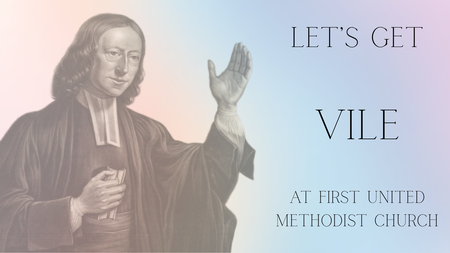
Today brings us to the end of this series where we have been exploring the vile origins of Methodism. I’m going to admit, last week was kind of a bummer. For a movement that began by challenging the systems of inequality and oppression while affirming the sacred worth of all people, Methodists evolved into a people that excluded more often than they included, segregated more often than they reconciled, and acquiesced to popularity more often than they challenged the status-quo. But we need to acknowledge that there has always been an undercurrent of inclusion in the Methodist movement.
Let me tell you about Jarena Lee. Jarena was a free black woman living in Philadelphia in the early 19th-century. She was part of the African Methodist Episcopal Church, a breakaway denomination started by Bishop Richard Allen that challenged the Methodist Episcopal Church’s acceptance of segregated worship. Jarena heard Bishop Allen preaching at Mother Bethel AME Church when she felt called to preach. Jarena approached Bishop Allen and told him about her calling. He responded that the church “did not call for women preachers.”
Last week I shared a history in Methodism of women coming forth to be leaders in the church and being told the same thing that Jarena Lee was told, that the church did not call women to preach. Jarena was glad to hear it actually, glad to have an excuse not to follow a calling that she knew would be difficult and hard. But God did not rest in her life. Eight years later she again felt the call to preach while listening to a sermon by Rev. Richard Williams. That sermon was so lackluster that Jarena Lee sprang to her feet and began to preach herself.
She later said that she was sure that she would be expelled from the church for her indecorum. Instead, Bishop Allen confesses that he had made a mistake 8 years earlier when he turned Jarena away. This story reminds me of all those times the church has turned away from its welcoming and accepting nature, only for God to keep forcing the issue, eventually softening hardened hearts and expanding the movement in new and powerful directions.
Let me tell you a little about Francis Willard and the Do Anything movement. Willard was the president of Evanston College for Ladies and a leader in the Woman’s Christian Temperance Movement. This was all in the late 1800s. At that time the temperance movement was part of the very progressive wing of Christianity that allied itself with women’s suffrage and the right for women to be ordained by the church. Williard was elected as a lay delegate the General Conference of the Methodist Episcopal Church, but was never seated as a delegate because she was a woman.
One of Willard’s initiatives was called Do Anything. The idea of Do Anything was that anything women could do to make small changes in their local context, could have an impact on larger systems and lead to change. One example of Do Anything was women sharing information with their local pastors on the need for the ordination of women. Educating pastors of local churches would lead to those pastors supporting change in their Annual Conferences, and changes at the Annual Conference level would lead to change at the General Conference level. Do Anything reminds us that there is no such thing as small change. The movement was involved in temperance, suffrage, the right to work, the right to equal education for women, and the right for women to own property. Willard reminds us today that small change can have big impact.
Our Gospel lesson shines light onto one of the core ways that our Wesleyan tradition understands our faith. Jesus tells the story of a robbery on the Jericho Road where a man is beaten and left for dead. Most of you probably know this story. Jesus uses the imagery of two supposed religious people ignoring the dying man to shine light on the supposed sinner, the Samaritan, being the one to stop and help. After the story Jesus asks who was a neighbor to the dying man. The answer is the Samaritan. Jesus affirms the answer and says to go and do likewise.
I like to think that in this story Jesus is revealing the nature of religion. That we may get so caught up in doctrines, with saying the right words, with dressing the right way, that we might miss the real goal of religious life—to be neighbors to one another. How are we to live our faith? By going out of our way to be of service to others.
At the core of Wesley’s understanding of religion was the idea that religion was social. For a man that spent so much of his life reading scripture, Wesley understood that reading your bible every day and going to church once a week wasn’t what Christian faith was all about. Christian faith was about the connections of care and love that we build between one another. Christian faith is a social faith.
Perhaps this is how we claim that vile nature of our Methodist heritage, by remembering that our faith is defined not by how well we can abide by the orthodoxy of the day, but by how well we can love others, especially those on the margins.
When the Methodist movement was just starting to gain popularity in England in the 1740s, it was not always peaceful. Methodists were challenging the status-quo, and often times these challenges were responded to with force. Violence was erupting on the streets. Speaking to this violence, Wesley wrote down some advice for the Methodists. He begins this advice by encouraging unity within the body and that Methodists should watch over one another in love.
There are five pieces of advice that Wesley offers Methodists, and I believe these are still as important today as they were nearly 300 years ago.
- Consider, with deep and frequent attention, the peculiar circumstances wherein you stand.
In 1700s England Methodists could not be identified by which church they walked out of on a Sunday morning. Methodists of that time were still part of the Church of England, they went to the same churches as everyone else. Instead, Methodists came to be known by their simple dress and speech, their willingness to serve others in ministry, and their desire to form relational communities with one another. Perhaps today we need to consider what it is that lets our community know that we are part of this vile movement called Methodism. People shouldn’t know that we are Methodist by which church we go to on Sunday morning, they should know it by the way that we serve those living on the margins, by the way we love those who have lived lives of rejection, and by the way that we welcome all to be part of the beloved community.
Here’s Ashley Boggan talking about the peculiar circumstances the United Methodist Church finds itself in today.
<play video>
Perhaps our invitation today is to consider what it means to be part of a movement that lays claim to the idea that no one gets left out or left behind.
- Do not imagine that you can avoid giving offense.
When Wesley talked about giving offense he was thinking about the origins of that term Methodist. A word that was applied to Wesley and his follows to ridicule them, but one that they accepted with gladness. Wesley wanted Methodists to offend people as they critiqued the powerful, as they broke long-held standards of decorum in the church and government, as they dared to see God at work in the lives of all people, as they called laypeople and even women to preach, as they challenged the evils of the Atlantic slave trade. In all these ways Methodists were going to offend the powerful and the privileged. The idea that you could be a Methodist without offending someone was unheard of.
Perhaps today we need to reclaim that willingness to be offensive. When we challenge unjust laws and the use of force by our own government against citizen and immigrant alike, we are going to offend people. When we give our support and love and care for our trans neighbors, we are going to offend people. When we confront the continuing harm that segregation and racism plays in our community, we are going to offend people. When we push for policies that address the climate crisis, we are going to offend people. Offending people is at the core of our faith. Guess what? When Jesus suggested that a Samaritan was the neighbor of an Israelite, he offended people. There is little of Jesus’ message that didn’t offend someone; the Empire, the wealthy, the religious authorities… all of them got offended by Jesus. Let’s do away with the idea that Christianity should be inoffensive.
- We can depend on God to give us courage to do this work.
We go to live our mission not purely out of a desire to make the world a better place. This work is a calling that has been placed on our lives and on our church. We are called to live this way, to do the work of coming alongside God and bringing justice and mercy and love into the world. We don’t do this alone. We go because God has sent us. We go with God to support and guide us.
- Never rest in the dead formality of religion.
Wesley saw a church that had become so formalized that it had lost all purpose. He saw people going through the motions of Christianity, but never letting the faith become alive in their lives. It is easy when we face challenges and opposition to pull back, to circle the wagons, to retreat to the walls of the church. To be Methodists though was never about the faith that happened in the walls of the church, it was about how we would live our faith in the rest of the world. Perhaps we are being invited in this age to consider how we challenge that dead formality of religion so that our faith can be a living and breathing thing.
- Advised against complaining about the ways we suffer and the things people say about us.
I probably don’t need to elaborate on this point. No Methodist I have ever met has complained. But maybe we could think of it in terms of how the world sees us. For years I lived in dread of seeing the United Methodist Church make national headlines. Every time the church would show up on the news it was because of some controversy that was happening, and most recently it has had to do with the split our denomination has undergone and the push to become a more affirming church. For years I was convinced that when non-church people heard about Methodists, they were hearing all our bad news, all our dirty laundry.
I think it matters how we present ourselves to the world. If we present ourselves as a people divided, people will see Methodist as divisive. If we present ourselves as a people who always complain, people will see us as complainers. If we look miserable when we are coming into church on Sunday morning, people will see us as being a miserable bunch of people. How we present ourselves matters.
Perhaps in reclaiming our vile nature, we need to present ourselves as those who are joyous to be in ministry in those corners of the world where hardship and rejection press on people’s lives. Perhaps we need excitement in being able to embrace a church that is open and accepting of all people. Perhaps we need to show our passion for being a vile kind of people.
Throughout the rest of this year we are going to be coming back to our roots, exploring our foundational beliefs, and discovering how the United Methodist Church might live out our vision to love boldly, serve joyfully, and lead courageously.
A couple of weeks ago I shared the Sankofa, the image of the bird facing forward while reaching back for an egg. As we live into the powerful future of the church together, it is my hope that we will be willing to reach back and grab hold of our heritage, while moving forward as we explore new ways to live into the affirming future that lies ahead of us.